

Am I even doing enough?
I’ve been hearing this a lot from data scientists lately. People who are genuinely good at what they do, but feel overwhelmed by how fast everything is changing.
Not sure where to focus. Not sure if what they’re learning even matters.
And honestly, it wasn’t that long ago that I felt that way too. Until I started approaching my learning a lot more strategically.
You see, for the past year, I’ve been obsessed with answering one question: What does it really take to future-proof my data science career? Not just in the context of AI, but in terms of how the field is evolving over the next few years.
That shift in focus has genuinely transformed my career, and for the first time ever, I feel like I’m ahead of the curve, not chasing it.
Today, I’m actively championing AI adoption at my company. I’ve been able to amplify my output at work in ways that have led to promotion discussions much sooner than ever before. I’m a stronger candidate in the market despite the competition. I’ve even been invited to give talks on agentic analytics.
But I didn’t get here by learning passively.
I got here by building, by studying the market, and by figuring out what actually matters. I’ve analyzed thousands of job postings to understand what companies really want from data scientists right now, and the picture is much clearer than the noise on social media makes it seem.
This article is my attempt to lay it all out in one place for anyone who needs it.
A practical, no-BS guide to future-proofing your data science career in 2026-2027, covering the skills, the strategy, and the mindset shifts that are actually making a difference right now.
Here’s what we’ll cover:
What the job market actually looks like right now (based on thousands of job postings analyzed)
The three pillars every data scientist should be investing in
Agentic analytics: what it is and why you should (really) care
Should you transition to AI engineering? (My honest advice)
A practical learning roadmap to help you get started
The most effective way to future-proof your career for AI 👈
You’ll definitely want to read this one until the end!
What’s actually happening in the job market
Let’s start with the data, because there’s a lot of noise out there and most of it falls into either “data science is dead” panic or “it’s all just hype” copium.
Neither is accurate.
Earlier this year, I scraped and analyzed 700+ Data Scientist job postings in the US spanning November 2025 through January 2026. I also drew on findings from a Harvard study that tracked nearly 285,000 companies and a report by Lightcast on generative AI hiring trends. Here’s what the picture actually looks like:
The fundamentals haven’t changed, but AI is now expected
Python, SQL, and machine learning still dominate job postings. No surprise there. But AI is now referenced in almost 60% of data science postings, and LLMs have entered the top 10 most requested skills compared to the previous year.
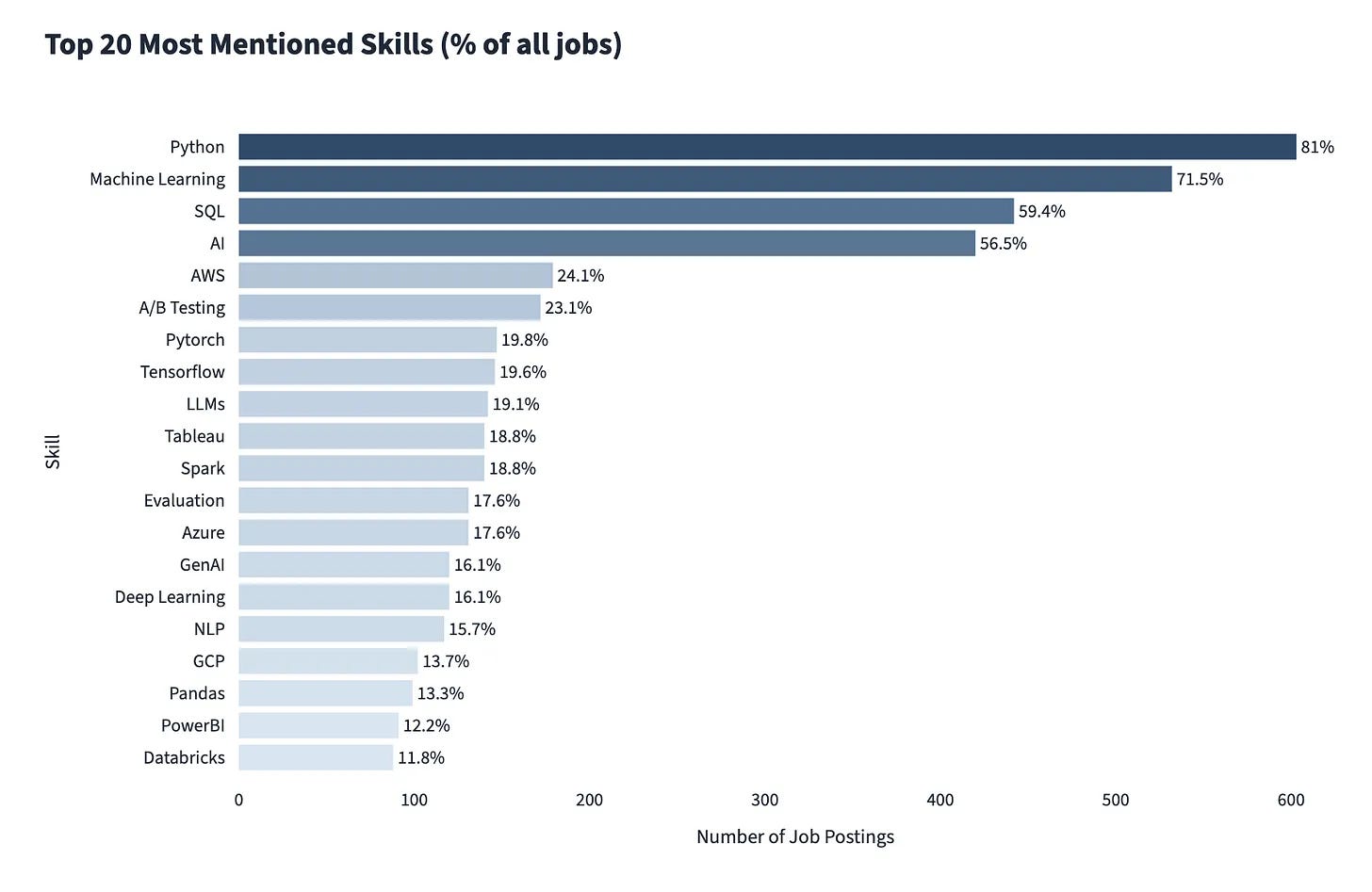
AI isn’t a niche specialization for data scientists anymore. It’s becoming part of the baseline.
Senior roles are growing. Entry-level is tightening.
The Harvard study showed something important: when companies adopt generative AI, junior hiring slows down while senior roles keep growing. Companies aren’t mass-firing juniors, but they’re hiring fewer of them. The routine work that used to justify those headcounts (cleaning data, writing basic code, drafting reports) is now handled more efficiently with AI.
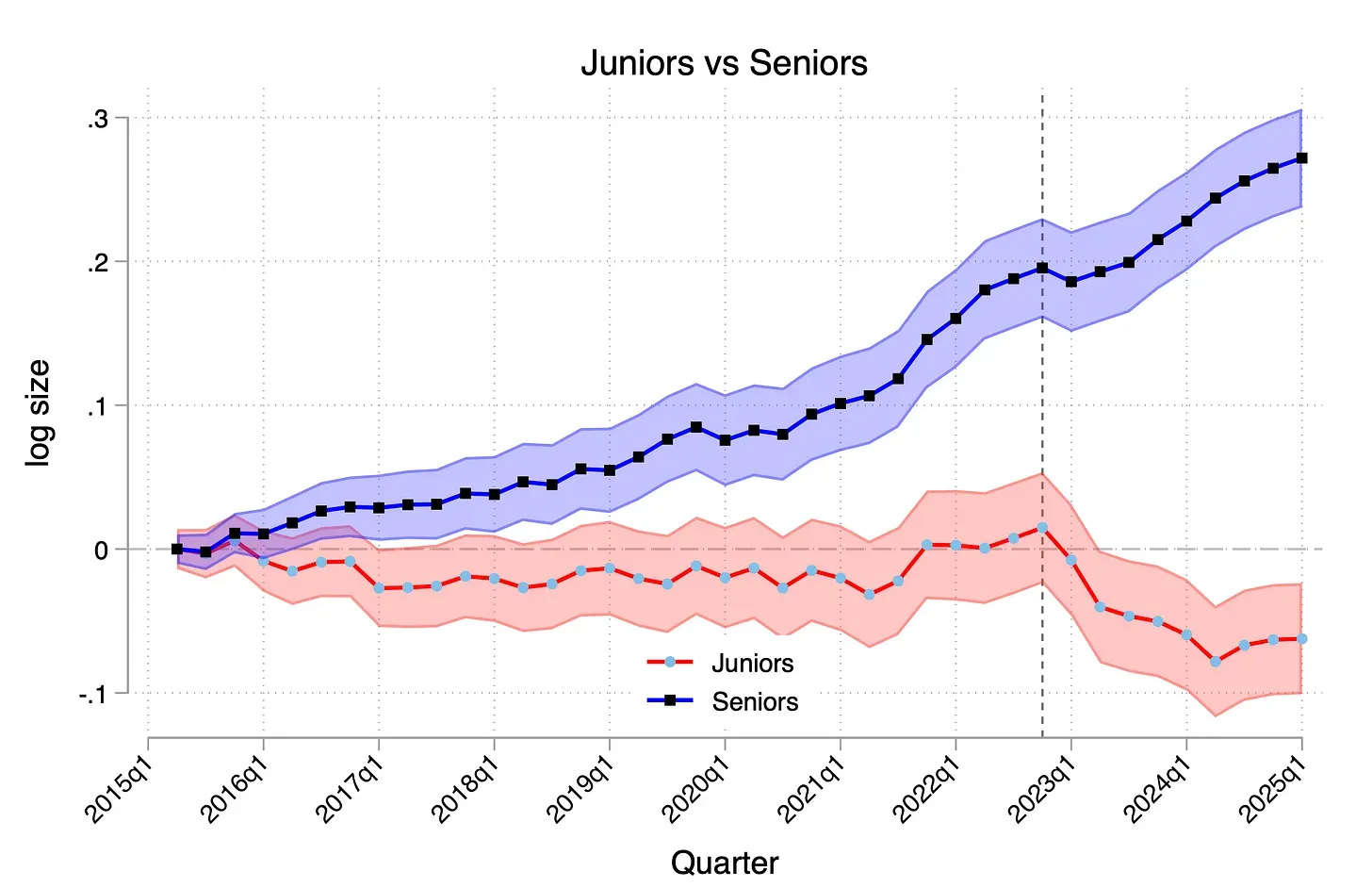
💡 The door into many companies is narrower, not closed. And for those already inside, opportunities haven’t disappeared. In fact, internal promotions for juniors actually went up in companies adopting AI.
AI-heavy roles skew mid-to-senior
When I looked at which seniority levels are being asked for AI skills, the pattern was clear: 73% of AI-focused postings target mid (43%) and senior (30%) data scientists. Entry-level accounted for less than 6%.
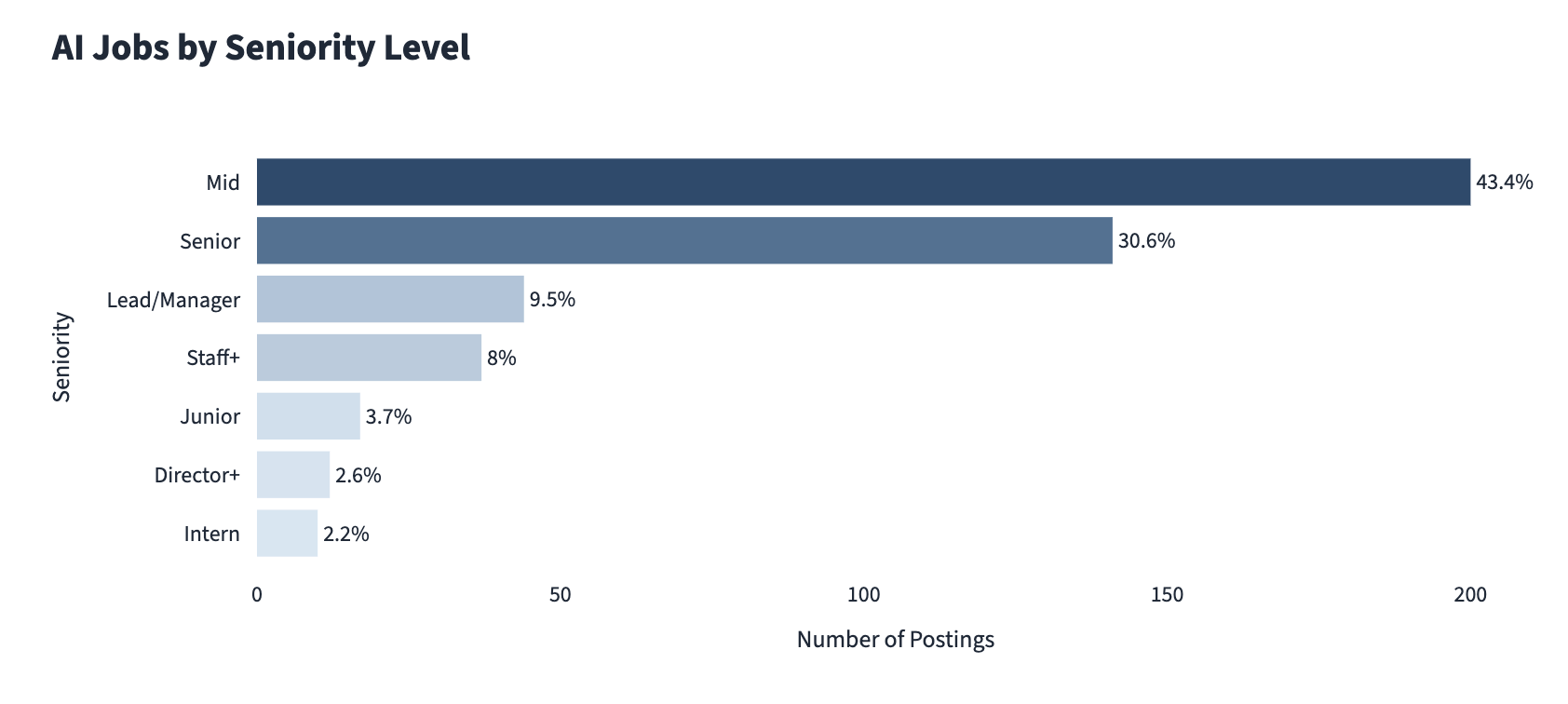
This reinforces what I’ve been saying for a while now: companies mainly expect experienced practitioners to be the ones who translate AI capabilities into real systems and business outcomes.
There’s an emerging salary premium
Roles that explicitly mention AI tend to show higher median salaries across most seniority levels. The signal is still early (salary data was only available for about a third of postings), but it’s directionally clear: AI skills are starting to pay more.
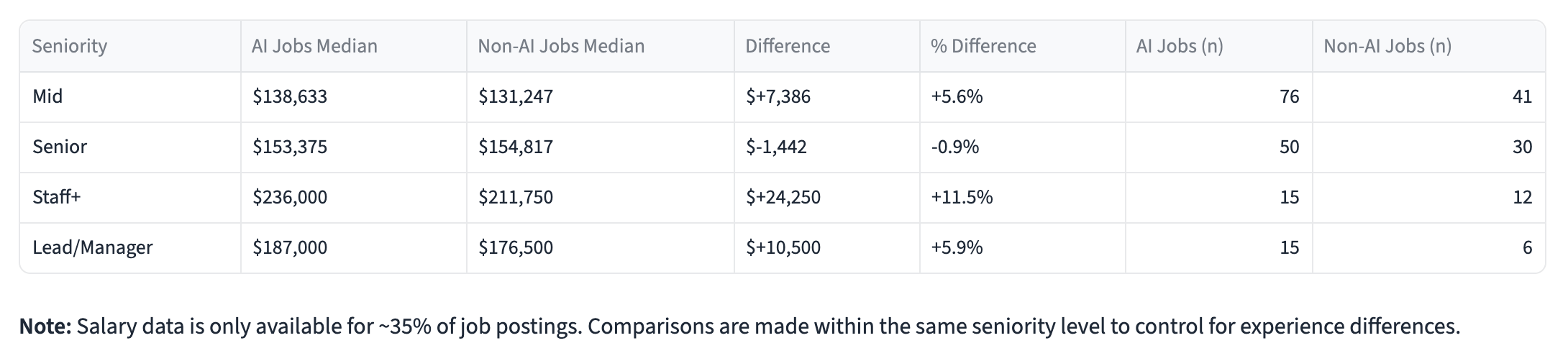
💡 If you want the full breakdown, including which specific AI skills are most in demand, I published the complete job market report here.
The three pillars of a future-proof data science career
Now that we’ve seen what the market is asking for, let’s talk about how to respond.
What I’m about to share are the three areas I believe every data scientist should be investing in right now, regardless of seniority (although how you prioritize each does depend largely on your goals and your seniority).
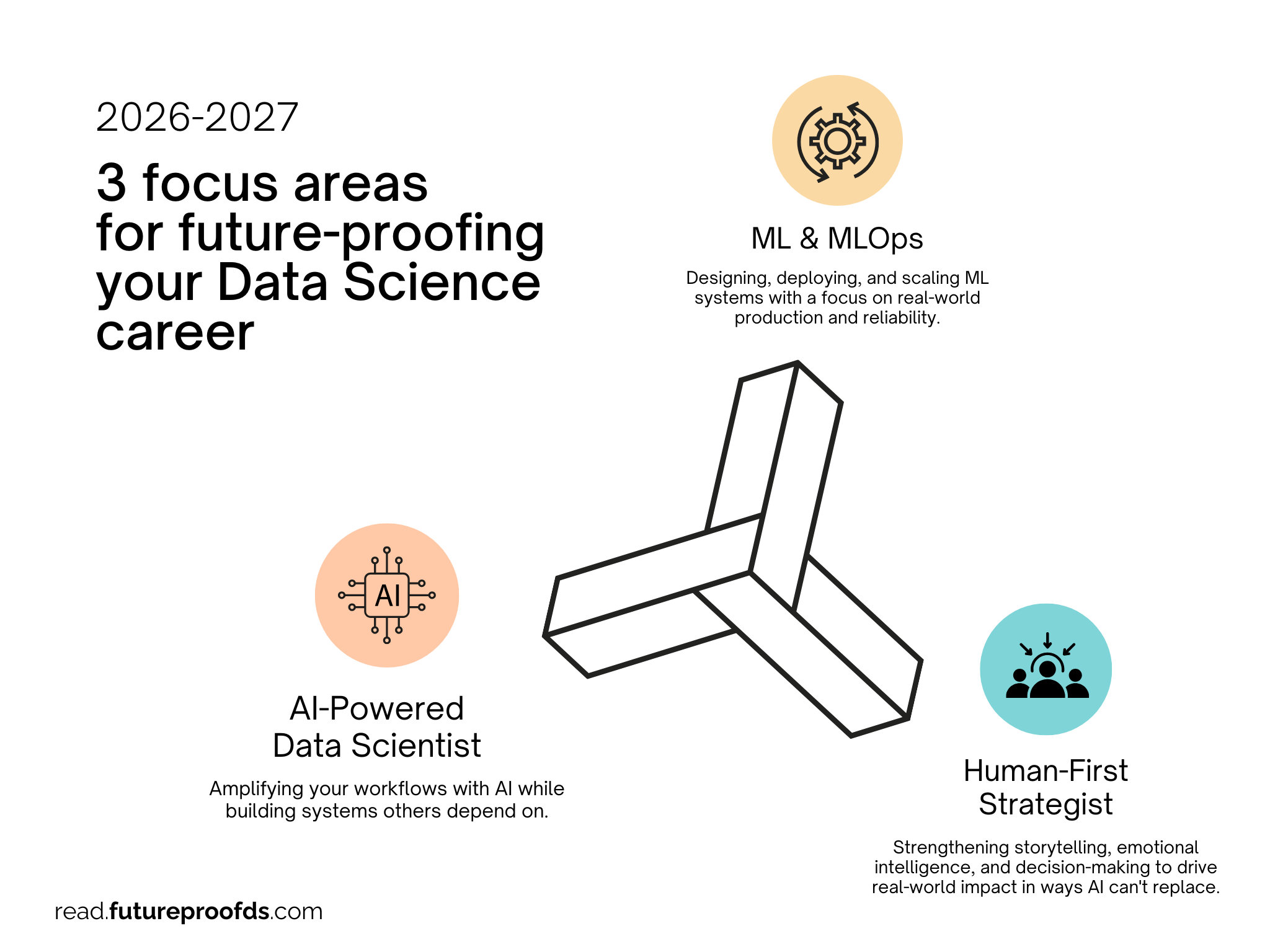
But I want to be clear about why these three specifically.
The goal isn’t just to “keep up with AI.” The goal is to make yourself full-stack enough to navigate the market in almost any direction. Whether you want to stay in a data science role, move into AI engineering, step into leadership, or even build something on your own, these three pillars give you the foundation to choose.
And that’s the real future-proofing, in my opinion. Not clinging to a job title, but building the kind of skills that give you options no matter how the field evolves.
Pillar 1: AI-Powered Data Scientist
This is about making AI a core part of how you work, not just a side tool you occasionally prompt.
Right now, most data scientists are using AI for ad-hoc tasks: fixing code, generating documentation, and summarizing results. And that’s fine as a starting point. But the gap between that and what the market is starting to expect is widening quietly. If that’s where your AI usage stops, you’re building on a false floor.
The next level has two sides to it.
The first is using AI to amplify your existing work. Automating data cleaning and early-stage EDA. Speeding up reporting. Getting through the repetitive parts of your workflow faster so you can focus on higher-leverage thinking. This alone can dramatically increase your output and make you more effective in your current role.
The second is building AI systems that create new value. Designing semantic layers that let AI reason over your company’s data. Enabling conversational analytics so stakeholders can query data in natural language instead of waiting on you. Building custom knowledge sources and RAG systems that give AI accurate, context-aware access to real datasets.
That combination, amplifying your work and building systems others depend on, is what separates someone who uses AI from someone who is indispensable because of it. It’s also what has made the biggest difference in my own career recently.
💡 About 1 in 3 AI-related job postings (31%) now require hands-on expertise across multiple specific AI skills: LLMs, RAG, prompt engineering, vector databases, and more. This isn’t conceptual. Companies want people who can build.
Pillar 2: ML & MLOps
Despite not getting as much attention as AI, this one is more relevant than ever.
The data science role is becoming more full-stack. Job descriptions are increasingly expecting data scientists to build ML/AI systems end-to-end, from development through deployment and monitoring. Companies don’t just need insights anymore. They need robust, scalable solutions that deliver value beyond the notebook.
If you’re not already investing time in things like:
Model deployment and monitoring
System design for ML pipelines
Tools like Vertex AI, MLflow, or similar platforms
Python packaging (Poetry, UV) and data validation (Pydantic)
...you should start. These aren’t “nice to have” skills anymore. They’re showing up in job descriptions for standard Data Scientist roles, not just ML Engineer positions.
This is also the pillar that opens the door to AI Engineering if that’s a path that interests you (which we’ll discuss in later sections of this guide). The overlap between a strong data scientist with MLOps skills and an AI Engineer is bigger than most people realize. I’ve been leaning back into this area myself, and it’s been one of the most valuable investments I’ve made.
Pillar 3: Human-First Strategist
Here’s the mistake a lot of people make: they think AI skills alone are enough.
They’re not.
As AI levels the playing field technically (everyone gets access to the same tools, the same models, the same capabilities), your human side becomes the differentiator. The ability to communicate clearly, tell a compelling story with data, and influence decisions is what will set you apart when everyone around you can prompt their way to a decent analysis.
The skills that make you truly resilient in this market are the ones AI cannot replace:
Business acumen: Connecting your work to outcomes that matter, whether that’s revenue, retention, cost savings, or growth
Strategic communication: Knowing how to distill complex ideas into something that drives action, not just understanding
Stakeholder influence: Building the trust and alignment needed for your work to actually shape decisions
Domain expertise: Understanding the industry and context behind the problems you’re solving, something no model can learn from a prompt
These are about judgment and influence, not just execution. And no matter how good AI tools get, they can’t replicate that.
The data scientists who will stand out in the next few years won’t be the ones with the most technical skills. They’ll be the ones who can pair those skills with the judgment to know what matters, the communication to make it land, and the influence to turn insights into action.
💡 If you want to stay valuable, combine technical proficiency with these human skills. That mix is what makes you more than someone who can query data. It makes you someone who can drive outcomes. I wrote a full article on the traits that accelerated my career growth if you want to dig deeper.
Agentic Analytics: The Shift You Can’t Ignore
If you haven’t heard this term yet, you will. A lot.
Agentic analytics represents a fundamental shift in how data work gets done. Instead of data professionals manually querying databases, building dashboards, and writing reports, AI agents step in to automate and augment large parts of that workflow, using natural language, business context, and structured reasoning.
And the backbone of this shift? The semantic layer and ontologies.
What’s a semantic layer (and why should you care)?
Think of a semantic layer as a shared definition of your company’s data (metrics, business logic, relationships) that sits between raw data and anything that consumes it (dashboards, notebooks, AI agents, stakeholders).
The concept has actually been around since the 1990s. Looker modernized it with LookML, but what’s different now is that semantic layers are no longer just powering dashboards; they’re becoming the interface through which AI agents reason about data.
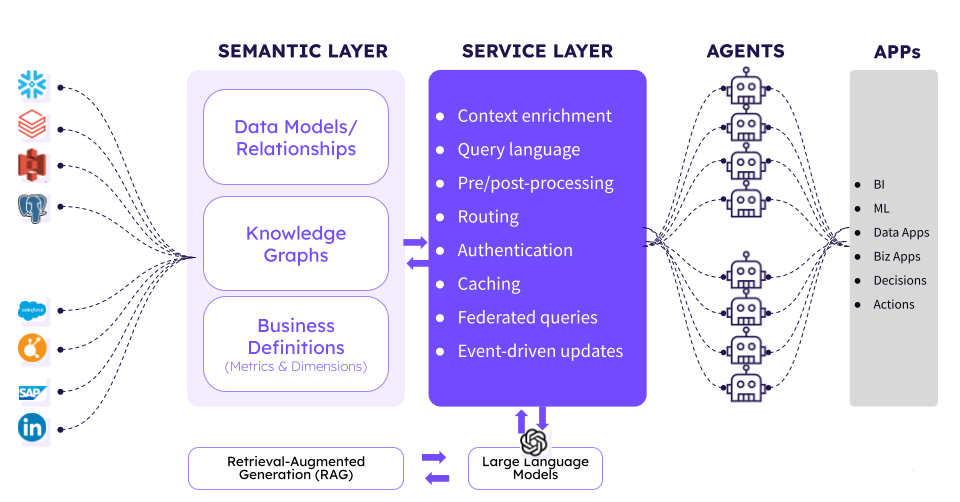
💡 In September 2025, major companies like dbt Labs, Snowflake, Google, Cube, and others came together to announce the Open Semantics Initiative (OSI), a shared standard for how systems define and communicate business context. This is a big deal.
What does this mean for you?
Here’s my take: by the end of 2026, the idea of a semantic layer will start moving from cutting-edge to expected. We’ll see more “conversational analytics” capabilities across platforms, and data scientists who understand how to build and shape these semantic layers will have a significant edge.
I’ve experienced this firsthand. I recently deployed a talk-to-your-data Slackbot at my company, and one of the keys to its success was defining the semantic layer properly. You don’t need to be a data engineer to start building one. But you do need to understand why it matters.
💡 Agentic analytics, semantic layers, and ontologies are already showing up in job postings. In small numbers now, but my bet is that this will only continue to increase. Data scientists who are part of this design process early will be the ones shaping the next generation of analytics, not just reacting to it. I go into much more detail in my article on Semantic Layers and the Future of Agentic Analytics.
Should you transition to AI Engineering?
This is one of the most common questions I see data scientists wrestling with right now. And it’s a fair one, because the hype around AI Engineering roles is real. The salaries are attractive, the work sounds exciting, and the job postings are everywhere.
But before you start rewriting your LinkedIn headline, here’s what you need to know.
First, understand what AI Engineering actually is
Strip away the hype, and AI Engineering looks a lot like software engineering applied to AI systems. It’s about designing, building, and operating intelligent applications reliably in production. Less emphasis on exploratory analysis and stakeholder storytelling. More emphasis on architecture, state management, evaluation frameworks, and deployment.
It’s a spectrum, not a binary switch
What a lot of people often overlook is that the data science role is already evolving to include more AI-focused work. As the market demands more experience with AI, many data scientists are now building foundation models for tasks like recommendation, designing RAG pipelines, running AI evaluation frameworks, and even orchestrating agentic workflows.
So this isn’t necessarily about changing your title. It’s about where you sit on the spectrum between analysis-focused and systems-focused work, and how far you want to take it.
It might be right for you if...
You might genuinely thrive in AI Engineering if you:
Feel more energized by building systems than analyzing outcomes
Enjoy debugging integrations more than interpreting experimental results
Get excited about architecture decisions, not just model accuracy
Were always drawn to the engineering side of data science
But it’s not for everyone
If what gives you satisfaction is shaping decisions rather than shipping infrastructure, then moving fully into engineering could disconnect you from what you actually enjoy.
There is good money in AI Engineering, and the work is exciting. But alignment with your interests is what sustains a career over time. That’s what truly future-proofs you, not chasing the hottest job title.
💡 I wrote a full deep dive on this topic: Should You Actually Transition from Data Science to AI Engineering?. Worth reading if you’re seriously considering this path.
A practical learning roadmap
Before I share specific resources, I want to talk about how to approach learning this stuff, because the mindset matters more than the material.
The framework: build, break, learn, repeat
If you take one thing from this section, let it be this: build something, get stuck, go back to the theory, then build again. That loop is the fastest way to actually internalize these skills. Not watching a 10-hour course end-to-end. Not collecting bookmarks you’ll never open.
You start a project. You hit a wall. You go figure out why. Then you come back and keep going.
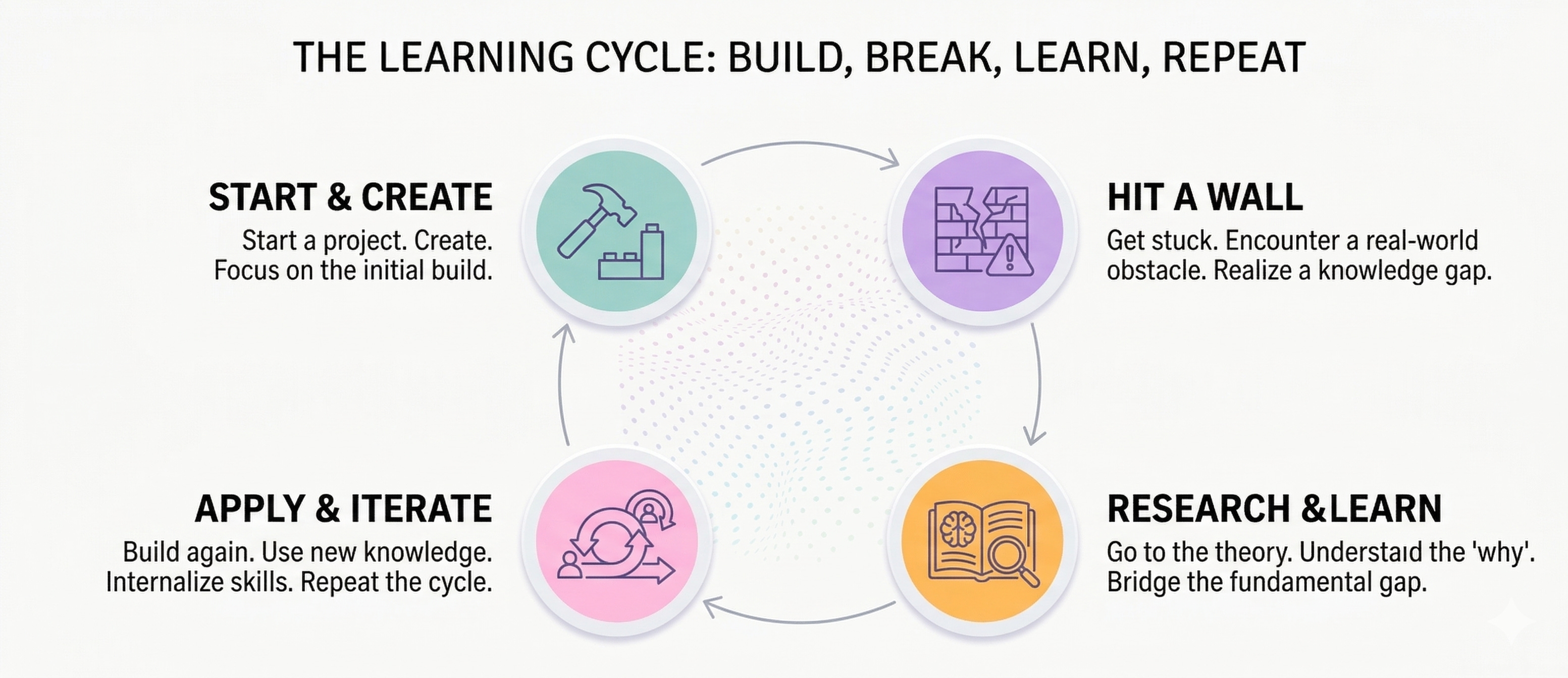
This also means there’s nothing wrong with “vibe coding” your way through the early stages. Use Claude Code, use Copilot, let AI help you move fast. But know that it will only get you so far. There’s a point where you need to stop asking “does this work?” and start asking “do I actually understand why?”
That’s when the real learning happens. And tools like NotebookLM or ChatGPT are great for bridging that gap, especially when your time outside of work is limited (which, for most of us, it is).
The foundations matter more than people admit. Knowing what’s actually happening inside the loop, or why an architecture behaves the way it does, changes how you build. It changes the questions you ask. And it’s the difference between someone who can follow a tutorial and someone who can solve problems their team actually has.
Resources I recommend
Here are just a few of the resources that have helped me the most. You don’t need to go through all of them linearly. Pick what’s relevant to where you are right now and come back to the rest when you need it.
📚 Books
AI Engineering by Chip Huyen. The best resource I’ve found for understanding how to build AI systems in practice.
LLM Engineer’s Handbook by Paul Iusztin. Great for going deep on LLM-specific workflows.
Designing Machine Learning Systems by Chip Huyen. Essential for anyone investing in MLOps.
Storytelling with Data by Cole Nussbaumer. A practical guide to communicating insights clearly and driving decisions.
How to Win Friends and Influence People by Dale Carnegie. Timeless principles for building relationships and influencing others effectively.
🎥 YouTube Channels
AI Engineer: Huge variety of technical talks on building AI systems.
LangChain: Lots of great tutorials on building workflows and agentic systems.
Andrej Karpathy: Deep, foundational understanding of how LLMs work.
👨💻 Other gems
Introduction to LangGraph (Free course by LangChain)
System Design Concepts Course and Interview Prep by freeCodeCamp.org
Andrej Karpathy’s 1hr Intro to Large Language Models
Where to start
If you’re not sure where to begin, here’s a simple path that works:
Watch Andrej Karpathy’s 1hr Intro to Large Language Models: This gives you the foundational understanding of how LLMs actually work, which changes how you approach everything else.
Pick up AI Engineering by Chip Huyen: You don’t need to read it cover to cover. Focus on the chapters that are relevant to what you’re trying to build.
Build a simple LLM-powered data cleaning script: Call an LLM API, pass it a prompt that includes an overview of your dataset, and have it identify missing values and generate the code to clean it. Simple, useful, and the first step from using AI to building with it.
From there, go deeper: Explore agent frameworks like LangGraph, experiment with building more autonomous workflows, and start thinking about how these tools could solve real problems at your company.
Start small. Get it working. Then improve it.
💡 There are plenty of other great resources out there beyond what I’ve listed here. Don’t overcomplicate it. The path above is more than enough to get moving.
🚀 This is the most effective way to future-proof your career for AI
Everything you just read about becoming an AI-powered data scientist, the semantic layers, the agentic workflows, and building systems your team depends on, I had to piece together on my own over the course of a year. Through trial and error, building at work, studying on weekends, and understanding what the market actually rewards.
You could do the same. But it doesn’t have to take a year (or even months)
That’s why I packaged it all into the AI Workflows for Data Science bootcamp, a 6-week structured program that covers the applied AI skills this guide lays out in Pillar 1. It gives you the roadmap, the hands-on projects, and the support system to go from reading about these skills to actually building with them, in a fraction of the time it took me.
Built specifically for data scientists, by a data scientist, focused on the skills the market is demanding right now.
It’s already helped 40+ data professionals make this transition. If you’re serious about staying relevant in the market, this is the most effective path I know:
A final note
If you’ve made it this far, you are already ahead of 80% of data professionals out there.
The truth is, no one has this fully figured out, including me. I’m navigating the same uncertainty, making bets on where the field is heading, and adjusting as I learn.
But here’s what I do know after 8+ years in this field, after getting laid off, moving countries, going from analyst to analytics team lead, and now building AI workflows in production:
The people who will thrive aren’t the ones who learn the most tools. They’re the ones who build the right skills, stay curious, and actually ship things.
The market is shifting. The window to get ahead of that shift, instead of playing catch-up, is still open. But believe me, at the rate we are moving, it won’t stay open forever.
So pick a pillar. Start building. And don’t wait until you feel “ready,” because honestly, no one ever does.
You’ve got this. 🙏
A couple of other great resources:
🚀 Ready to take the next step? Build real AI workflows and sharpen the skills that keep data scientists ahead.
🤖 Struggling to keep up with AI/ML? Neural Pulse is a 5-minute, human-curated newsletter delivering the best in AI, ML, and data science.
Thank you for reading! I hope this breakdown helps you get started future-proofing your career.
- Andres Vourakis
Before you go, please hit the like ❤️ button at the bottom of this email to help support me. It truly makes a difference!