

Wait, I’m allowed to use AI for this?
That was my first thought when I joined a live coding interview with Spotify and was told the AI assistant in the editor was fair game, which goes against the one rule every technical interview I’ve done has had: no outside help.
Look, AI is certainly changing more than just how we do our work.
And I’m not the only one noticing a shift. Lately, I keep seeing claims that coding interviews are dead, and some of them come from the people doing the hiring. In a recent essay, Felix Rieseberg, an engineering manager at Anthropic, wrote: “As a hiring manager at Anthropic, I stopped asking candidates to do them.” His reason is that Claude now does better on those tasks than candidates do.
So is the coding interview actually dead?
Not quite! A handful of companies have certainly changed how they interview, but most haven’t, and for data roles the evidence of change is still thin.
I dug into how technical interviews changed this year, with a focus on data roles, to figure out what you should actually prepare for 2027.
Here’s what we’ll cover
My own experience interviewing with Spotify
Where companies really stand on AI in interviews (spoiler: they don’t agree)
What this looks like for data scientists specifically
What interviewers are actually grading now
How to prepare for interviews in 2027
Alright, let’s get to it!
My Spotify interview
This was an interview for a consulting assignment at Spotify. Since it wasn’t Spotify’s full-time hiring process, I can’t say every team there interviews this way, though honestly, I wouldn’t be surprised if they did.
The technical round was a live coding session on CoderPad, with SQL and Python questions.
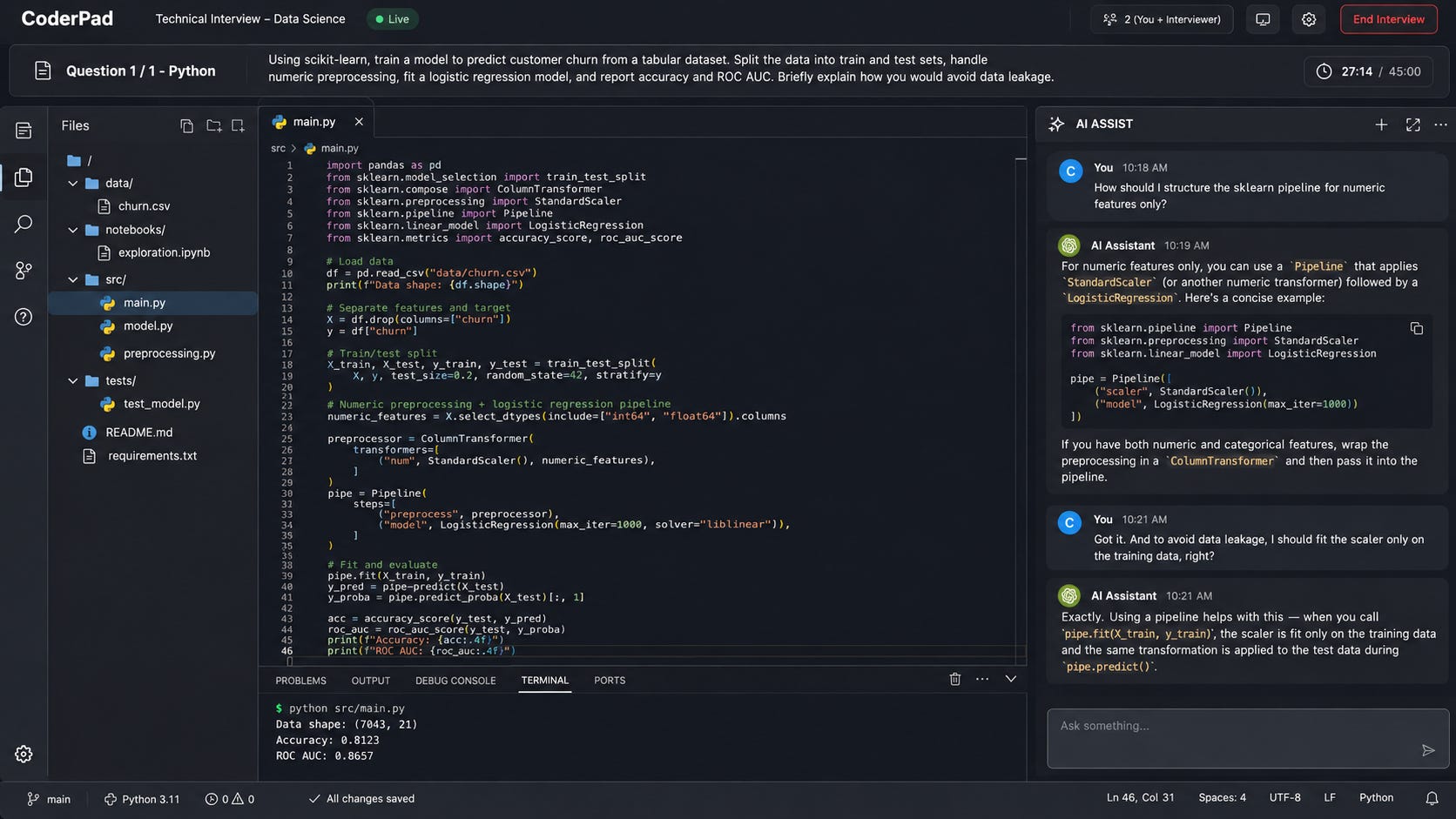
Before we started, I was told I could use CoderPad’s built-in AI assistant. Nobody said whether using it would count against me, and I don’t think it did:
For SQL, I chose not to use it at all and worked through the question on my own.
For Python, I was upfront and told the interviewer that I rarely write Python by hand anymore, since most of it is written with AI these days, so I’d likely need help with syntax. I then used the assistant for the specific parts where syntax was slowing me down, rather than to answer the whole question.
But this was just one interview, so let’s look at what’s happening across the rest of the field.
Companies don’t seem to agree on AI in interviews
The companies that have shared how they interview fall into three camps.
Camp 1: AI allowed
Canva replaced its computer science fundamentals screen with an AI-assisted coding interview where candidates bring their own tool (Copilot, Cursor, or Claude), and it covers machine learning engineers too.
Shopify runs two AI-enabled coding rounds.
Meta reportedly added an AI-enabled round for software engineers, in CoderPad with an AI chat panel.
Google is piloting a round with Gemini for some engineering teams, where interviewers score AI fluency.
Camp 2: AI banned (by default)
Anthropic’s official candidate guidance (last updated in July 2025) says no AI in take-homes or live interviews unless you’re told otherwise, though some teams make exceptions (yes, the same company where one manager just dropped coding interviews).
Datadog doesn’t allow AI in live rounds unless the round is announced as an AI coding interview.
Amazon banned AI tools in interviews back in 2025.
Camp 3: Changed the format entirely
Cursor keeps its first screens AI-free, then brings candidates in for two days to work on a real project.
Linear ends its process with a paid work trial.
Felix himself is now scanning resumes and portfolios for small prototypes instead.
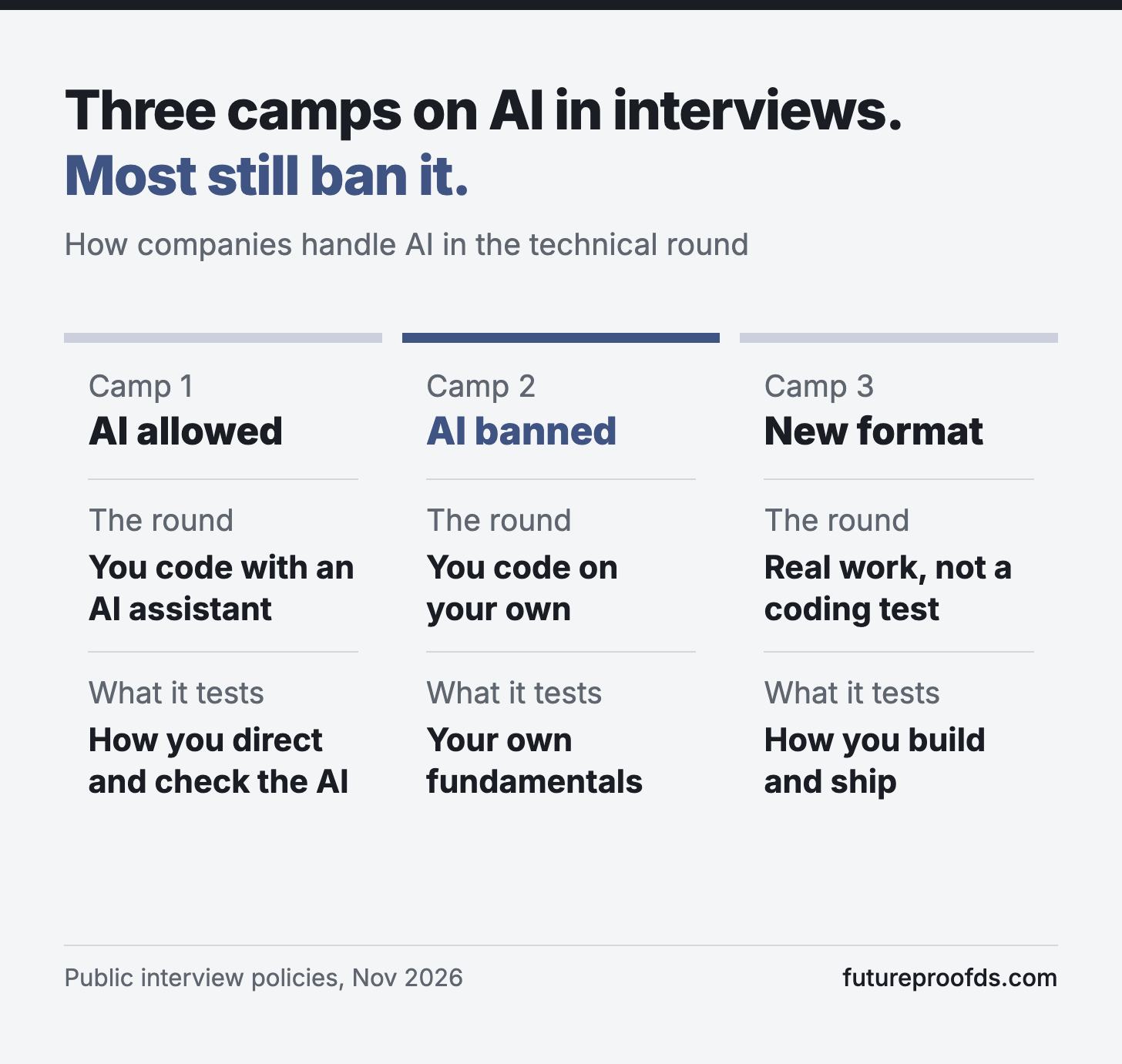
But from what I can tell, most companies are still in camp 2. In Karat’s survey of 400 engineering leaders, 62% of US organizations still prohibit AI in technical interviews. (By the way, Karat sells interviewing services, so take the exact number with a grain of salt, but the direction matches everything else I found).
Even Felix admits he hasn’t figured out what replaces the coding interview yet, so calling it dead says more about the headlines than about his essay.
One important caveat before we move on: almost every example above comes from software engineering, and Canva is the only company that explicitly mentions machine learning roles, so for data scientists the picture is a lot blurrier.
What this looks like for data scientists
I couldn’t find a single company that publicly confirms AI is allowed in a data scientist’s live SQL or Python round. Which makes my Spotify interview a rare first-hand look at what an AI-allowed data science round can look like, even if one interview can’t tell us yet how common they are.
A few patterns do show up for data roles:
AI on the take-home, not in the live round: OpenAI’s data scientist loop reportedly encourages AI on a 48-hour take-home, but not in the live SQL and Python review that follows (according to a prep company’s guide). Datadog works similarly: AI is fine on take-homes as long as you can explain the work. In other words, you might use AI to produce the work and then have to defend every line of it without AI.
SQL rounds are turning into code reviews: Amney Mounir describes an analyst candidate who was told they’d have AI during the SQL round. The job shifts from writing the query to reading the AI’s draft, explaining it, and catching what’s wrong with it.
Product sense is getting more airtime: Hiring managers say syntax checks are moving to screens and take-homes, while live time goes to business framing, metric design, and messy investigations (KORE1’s hiring guide), which happen to be the areas where AI still struggles the most.
ML rounds have new content: For ML-heavy roles, practitioner write-ups suggest system design questions are shifting from “design a recommender” to “design an LLM-based system,” with follow-ups on evaluation, retrieval, hallucinations, and cost.
What interviewers are actually grading now
Across everything I read, one shift keeps coming up: the skill being graded is moving from producing the right answer to staying in control of an AI that produces one.
As Canva wrote about its AI-assisted interviews: “The most successful candidates didn’t just prompt AI and accept whatever it generated.”
In practice, that comes down to four things:
Checking the output: reading what the AI wrote, catching the mistake, and explaining why it’s wrong.
Driving, not delegating: deciding what to ask for, and when to ignore the tool completely.
Framing a vague problem: clarifying what’s being asked, picking the right metric, and scoping before writing a single line.
Defending your own work: walking through every choice in your analysis, with or without AI in the room.
From my own experience, having AI available didn’t necessarily make the interview easier, instead it added one more decision on top of solving the problem, since I had to judge when the assistant would actually help and be clear with the interviewer about why I was using it.
How to prepare for interviews in 2027
Nobody knows exactly what interviews will look like next year, but everything above points the same way: a split market that’s moving slowly at big companies and faster at smaller ones, with the bar shifting from writing code to judging it.
So the safest strategy going into 2027 is to prepare for both worlds:
Ask about the AI policy upfront: Ask your recruiter about the AI policy before the technical round, and if nobody tells you, assume AI isn’t allowed, since that’s still the default at most companies.
Practice mostly without AI: Do most of your SQL and Python practice by hand, since most interviews still don’t allow AI, and you can’t catch an AI’s mistakes in code you can’t read yourself.
Do a few practice rounds with AI, out loud: For interviews where AI is allowed, rehearse a few problems with a built-in assistant and narrate as you go: what you’re asking for, why, and how you’re checking the answer. Decide ahead of time what you’ll use it for (syntax, boilerplate) and what you won’t (the core logic).
Rehearse defending your own work: Pick a past project and explain every decision in it without notes: why that metric, why that model, what you’d do differently.
Have a real answer for “How do you use AI in your work?” I would suggest this question “Walk me through how you used an AI assistant on your last analysis.”. It’s important to have a concrete story ready, and ideally a project that shows it.
If you’re early in your career….
Felix’s essay is titled “Hunger beats tenure.” He says he’s seeing newer engineers who work well with AI fly past people with many more years of experience.
It’s a hopeful take, and I think there’s real truth to it once you’re inside a company, but getting in is a different story.
It’s a hopeful take, and I think there’s real truth to it once you’re inside a company, but getting in is a different story. There’s clearly less demand for junior data scientists than there was a few years ago, and in the postings I’ve been tracking, fewer than 1 in 10 roles that ask for AI skills are aimed at junior candidates or interns.
But even with fewer junior roles to go around, the ones that do exist expect AI skills just as often as senior roles do (about 4 in 10 postings at both levels), so AI isn’t something you can leave for later in your career. If you want to see exactly which AI skills are showing up most, I broke them all down in this report on the AI skills data scientists need.
If you’re just starting out, two things matter more than ever:
Your fundamentals: You’re the one who has to catch the AI when it’s wrong, and that only works if you understand what it wrote.
Small projects that show judgment: That’s what the people redesigning these interviews say they’re looking for.
The formats will keep changing, and the companies running these interviews are still figuring them out too, so if you focus on those two things, you’ll be ready for whichever version of the interview you end up in.
A couple of other great resources:
🤖 Want to go from Chat Window to AI Analyst? Check out my free live workshop series for Data Scientists.
🎥 Want to follow along on YouTube? I just launched a channel for data scientists. Don’t forget to subscribe to not miss any videos.
Thank you for reading! I hope it helps you prepare for any upcoming interviews. Also, for those of you wondering, I did manage to get the job at Spotify :)
- Andres Vourakis
Before you go, please hit the like ❤️ button at the bottom of this email to help support me. It truly makes a difference!