

There’s no shortage of opinions about which AI skills data scientists should be learning right now, and with new tools coming out every day (literally), it’s hard to tell which ones actually matter to the companies hiring.
After 8+ years in this field, I definitely have my own opinions on this too. But at the end of the day, we’re data scientists, and we should base our decisions on actual data, not just on someone’s opinion, including mine.
That’s why, late last year, I started scraping US Data Scientist job postings, and I’ve kept at it ever since. I now have 7K+ postings collected over almost a full year, which is enough to confidently say what’s actually changing.
So in this article, I’ll walk you through what companies are actually asking for, what’s been changing over the past year, and what I’d do about it if I were you.
Let’s get to it!
AI shows up in 2 out of 3 postings, and about half expect AI skills from you
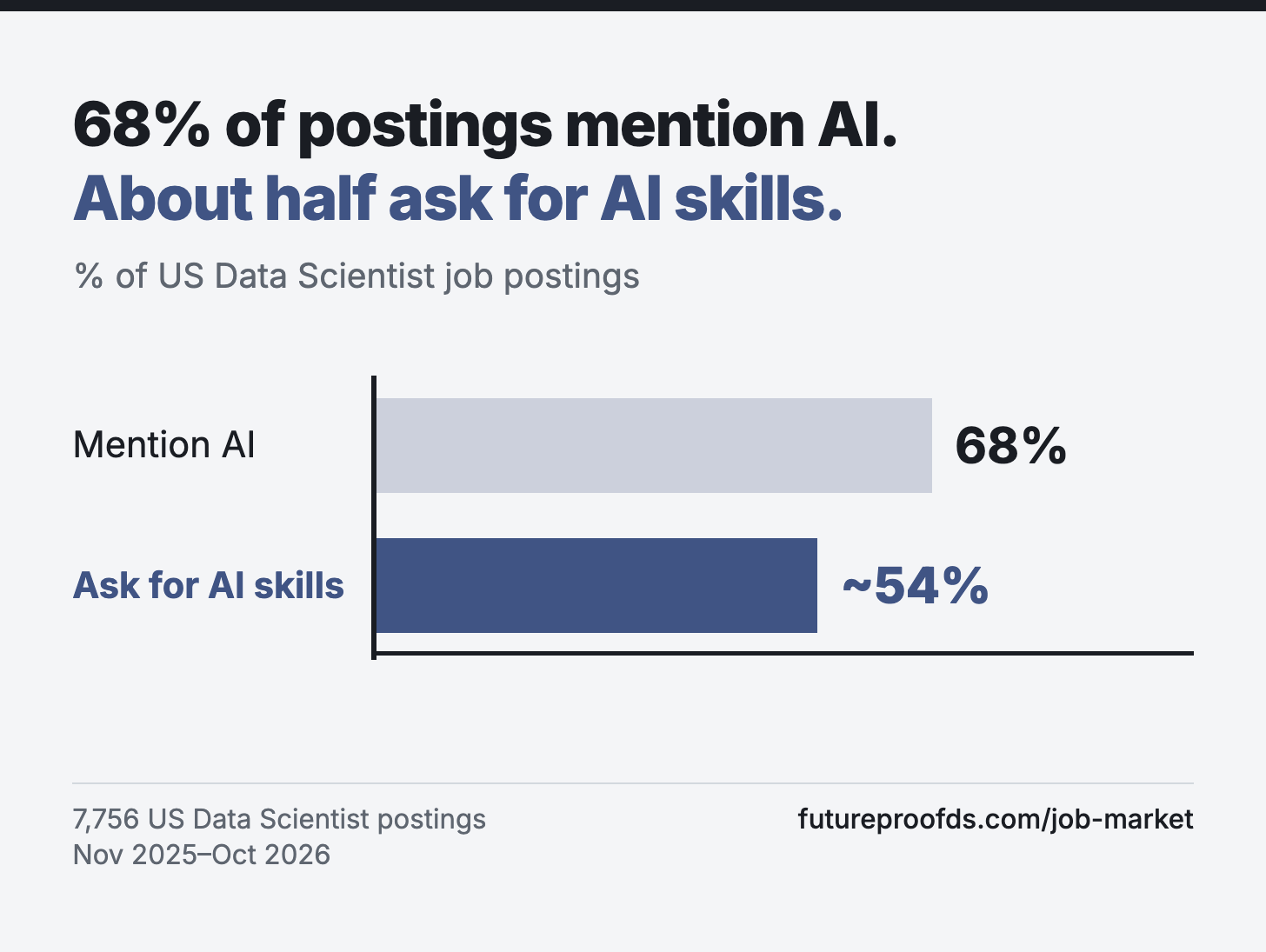
Whether it’s in the job requirements or in how the company describes itself, it’s clear that most companies hiring data scientists want to be seen as investing in AI.
And if we look deeper, in about half of all postings, companies are clear that they expect their candidates to have AI skills or to work on AI projects, many of them mentioning a specific skill like LLMs, RAG or AI agents.
What’s important to notice is that most of these aren’t AI-specific roles. Only 13% of postings have AI in the job title, which means that for about half of the market, AI skills are simply part of being a Data Scientist.
Most postings that ask for AI skills ask for more than one
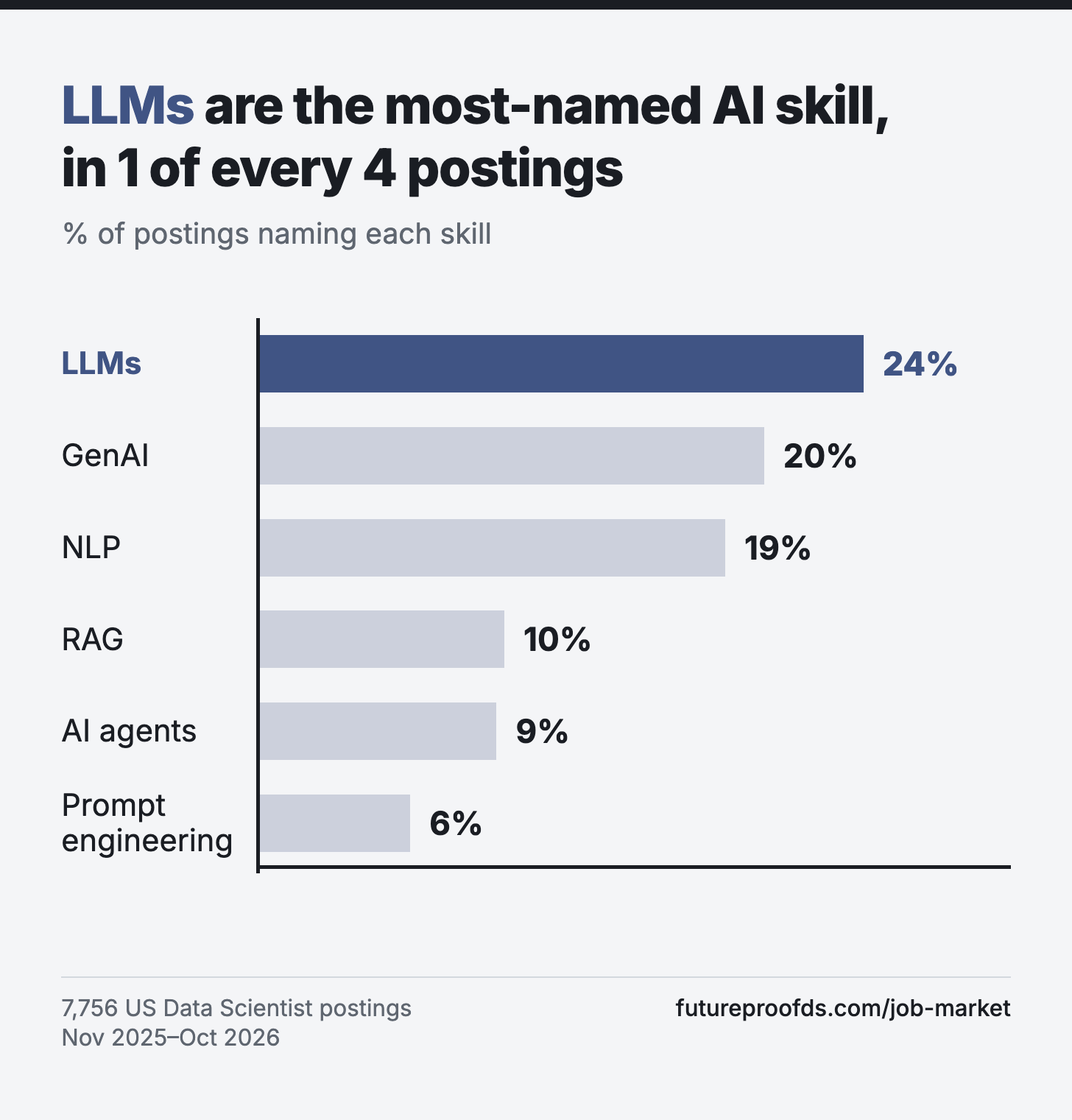
When companies name specific AI skills, LLMs come first, appearing in about a quarter of all postings, followed by GenAI and NLP. RAG and AI agents each appear in roughly 1 in 10 postings.
But what matters more for you is that most postings don’t stop at one. About 6 in 10 that name an AI skill name more than one, and some go much further. I came across job postings from Walmart, Deloitte and The Hartford asking for LLMs, RAG, prompt engineering and AI agents all in the same job description.
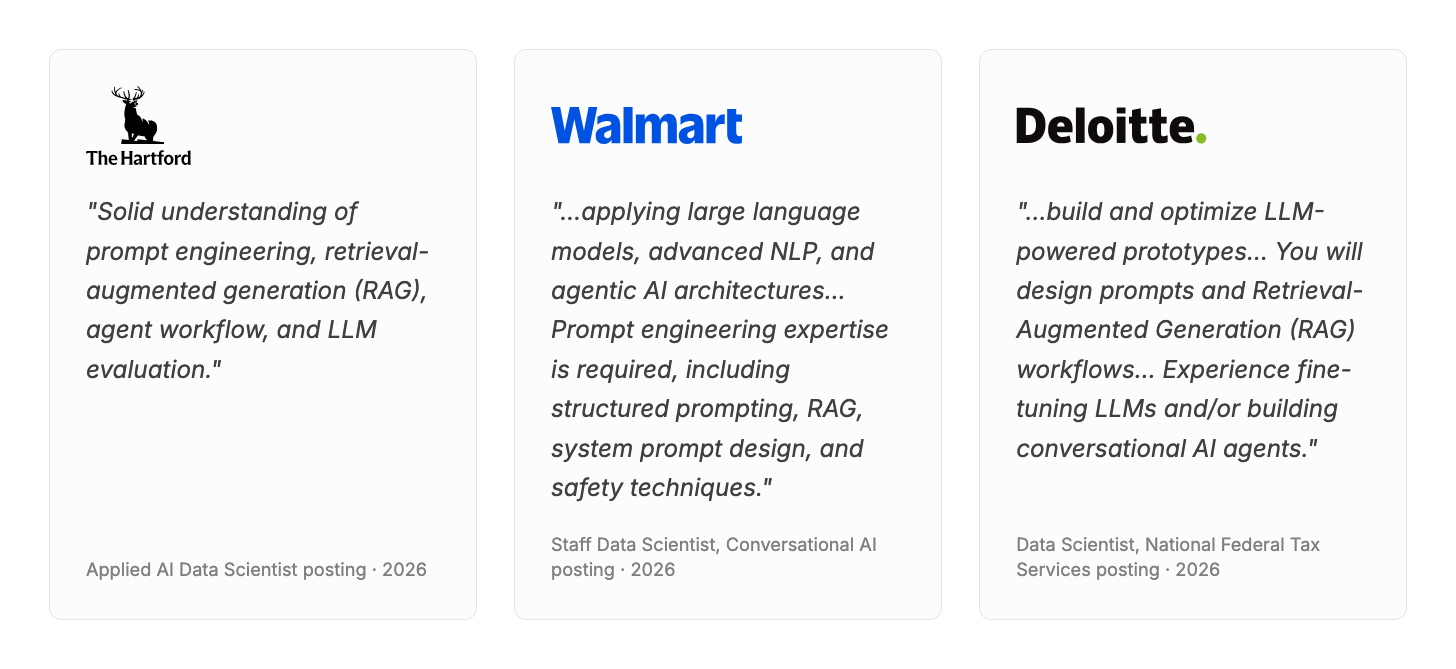
So learning one AI tool usually isn’t enough, companies want to see that you understand how several of them fit together.
AI agents and AI coding tools are showing up in more postings
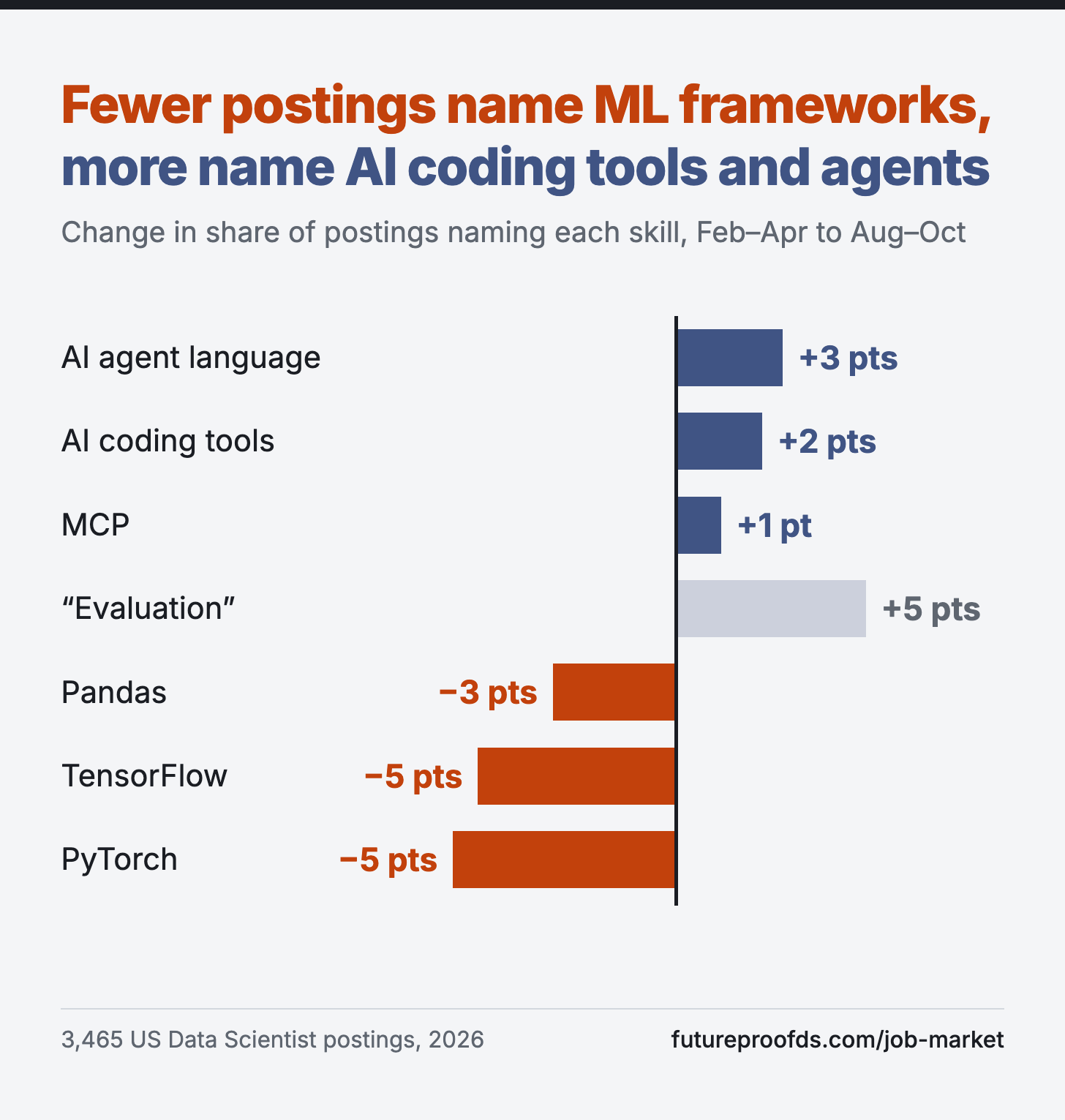
AI has been a steady part of about half of all postings since February 2026. What’s changing is which AI skills companies ask for.
On one side, AI agents, AI coding tools (like Claude Code, Cursor or Copilot) and MCP show up in more postings this fall than they did earlier in the year.
On the other side, PyTorch and TensorFlow dropped from about 16% to 11% of postings each, which is the most consistent change in the entire dataset. Now, to be clear, that doesn’t necessarily mean people are using them less, just that a smaller share of postings list them.
“Evaluation” also rose, from about 20% to 25% of postings, making it the fastest-rising keyword I tracked. And with more companies building AI systems, my bet is that knowing how to evaluate them will only become more important.
So here’s my take: companies care less about which tools you know and more about whether you can build systems with AI. It also matches what I see as a consultant, where almost every company I talk to is trying to figure out how to get AI working reliably on their own data.
Job postings that ask for AI skills are twice as likely to ask for production skills
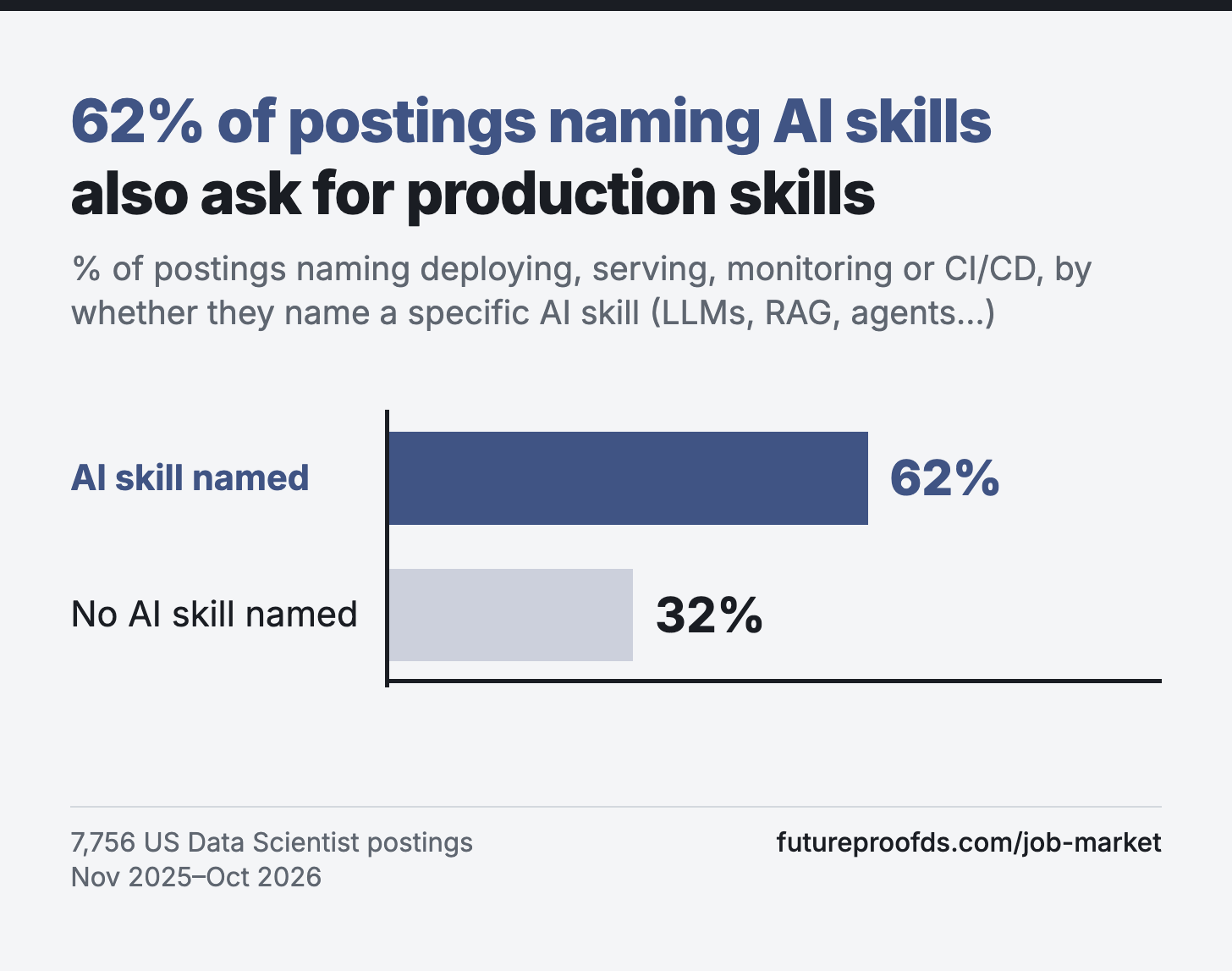
62% of postings that name an AI skill also ask for production skills like deploying, serving and monitoring models, compared to 31% of the ones that don’t. When a posting lists AI skills, the company usually isn’t looking for someone to experiment in a notebook. They want someone who can build things that actually run.
You can see this in the postings themselves. Some ask you to build AI systems:
Google, Senior Business Data Scientist, Agentic AI, Finance: “Experience building agentic workflows (e.g., ADK, context management, prompt engineering) to transform corporate processes…”
Amazon, Sr Data Scientist, Alexa For Shopping: “…build agentic, automated analytical workflows that enable fast, repeatable deep dives…”
Others expect you to use AI tools in your day-to-day work:
Expedia Group, Senior Data Scientist, Product: “You are proficient in SQL, R or Python, Tableau, and Claude Code or Codex.”
Verizon, Principal Data Scientist: “Utilize advanced coding assistants like Claude Code within VS Code to automate boilerplate and focus your energy on strategic problem-solving.”
Expedia listing Claude Code right next to SQL and Python tells me that using AI coding tools may soon be as basic an expectation as knowing SQL.
AI skills are now expected at every level, and even more once you aim for Staff+ and lead roles
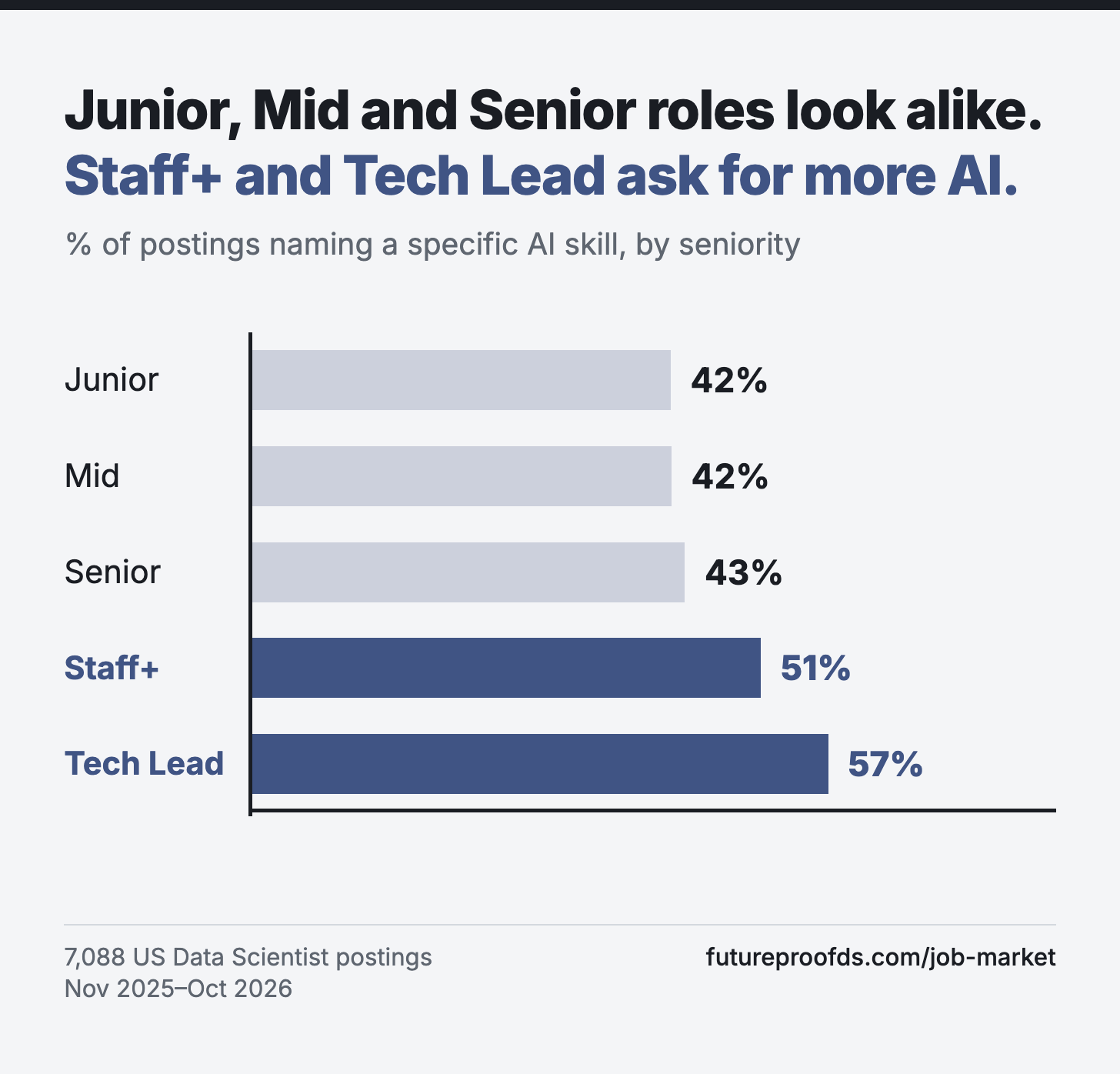
About 4 in 10 postings name a specific AI skill at every level from junior to senior (42%, 42% and 43%). From there it climbs, to 51% at Staff+ and 57% for Tech Lead roles.
This makes sense to me, because the more senior the role, the more you’re expected to lead how your team adopts AI, not just use it. That was true in my case too: leading the shift toward agentic analytics at my previous role, without anyone asking me to, is exactly what my manager read as seniority when I got promoted.
Postings that mention AI tend to come with higher salaries
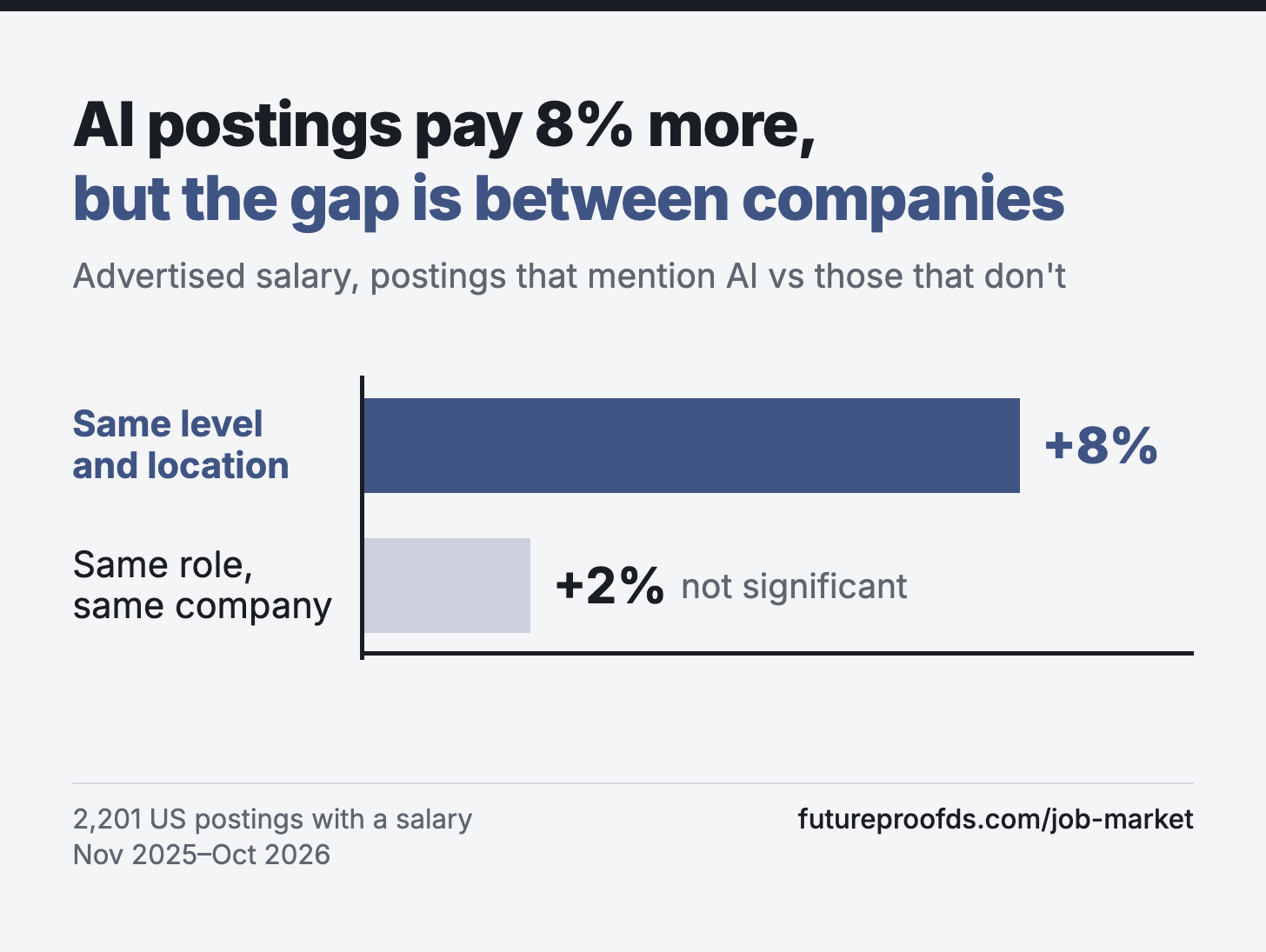
Postings that mention AI advertise about 8% higher salaries than postings for the same level and location that don’t.
When I dug a little deeper, the higher pay seems to come mostly from the type of company. The companies that talk about AI tend to pay more overall, while for the same role at the same company, the salary range looks about the same either way.
So the way I see it, AI skills are what get you into the companies with higher pay bands.
Summary
Here is a recap of the key findings:
How many postings expect AI skills? AI is mentioned in about 2 out of 3 Data Scientist postings, and roughly half expect the candidate to have AI skills or to work on AI projects. Most of these are regular Data Scientist roles, not AI-specific titles.
Which AI skills are named most? LLMs lead (about 1 in 4 postings), followed by GenAI, NLP, RAG and AI agents. About 6 in 10 postings that name an AI skill name more than one.
What’s changing? The share of postings naming AI skills has held steady at about half since February, but AI agents, AI coding tools and MCP now appear in more postings, while PyTorch, TensorFlow and Pandas appear in fewer.
What else do AI postings ask for? Production skills: 62% of postings naming an AI skill also ask for skills like deploying and monitoring models, compared to 32% of the rest.
Does seniority matter? About 4 in 10 postings name an AI skill at every level from junior to senior, rising to 57% for Tech Lead roles.
Do AI skills pay off? Postings that mention AI advertise about 8% higher salaries, mostly because the companies asking for AI tend seem to pay more.
What I think you should do going into 2027
Alright, that’s what the data says. Here’s my advice to all of you.
The field is changing, and there isn’t much any of us can do to stop that. What we can do is prepare for it.
For me, that means not treating AI as just another tool you open when you’re stuck. It means building systems around it: setups that manage the context of your data and your business, workflows that run parts of your analysis for you, and tools that speak directly to what your stakeholders need.
I’m in no position to tell you what this field will look like 5 years from now (honestly, nobody is). But I can tell you that learning these skills, and strengthening my technical foundation along the way, has already made a big difference in my career, and I’m confident it will help me with whatever comes next.
Now, if you want a structured way to start building these systems, this is exactly what I teach in the AI Workflows Bootcamp.
Over 6 weeks, you go from setting up your own AI analyst to building and evaluating an agentic analytics system end to end.
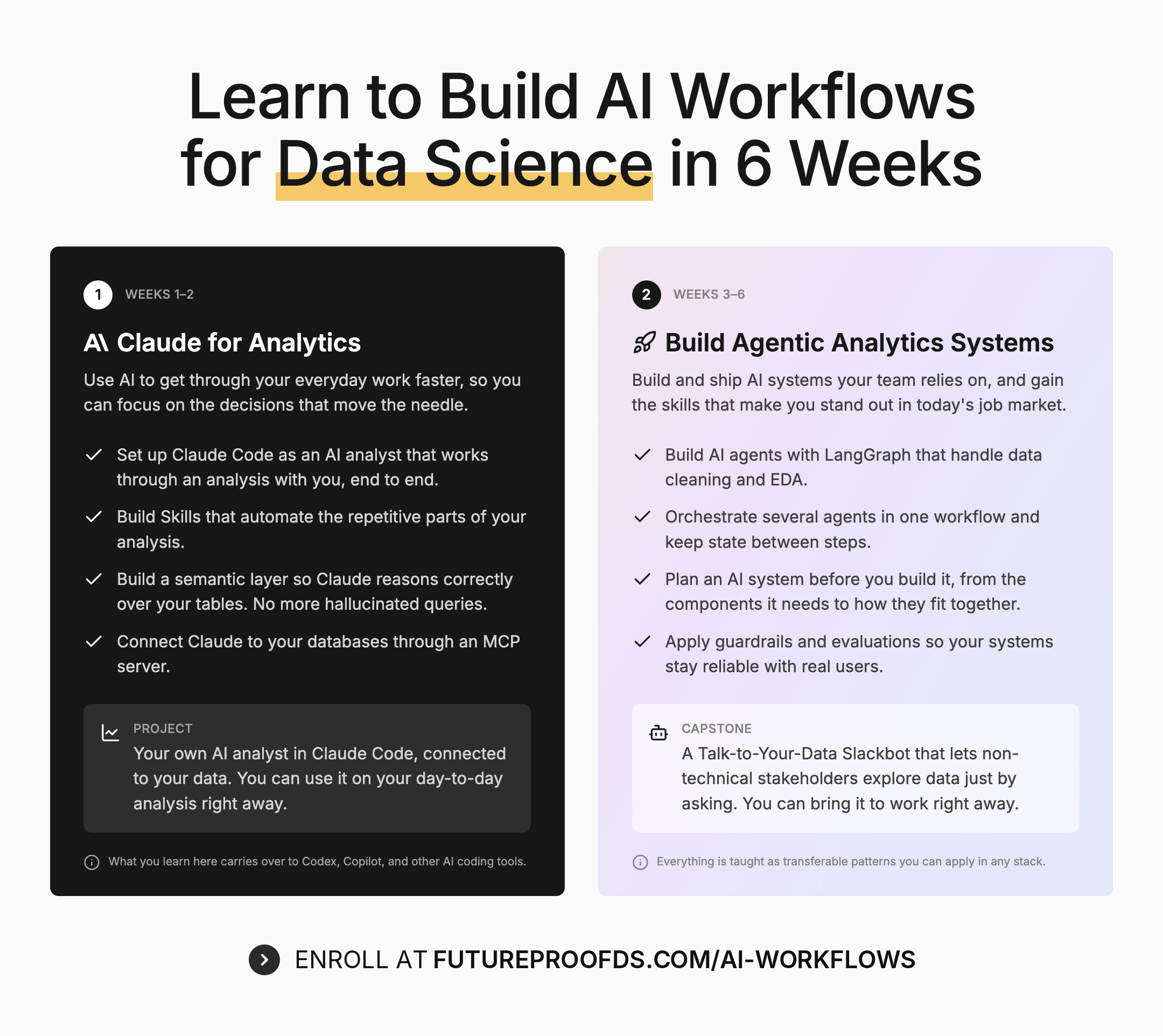
By the way, enrollment closes in only 5 days. Keep in mind that if you miss this cohort, the next one won’t be available for another 6 months.
Regarding the analysis approach
Source: Google Jobs results for “Data Scientist” in the United States, collected weekly from November 2025 to October 2026.
Cleaning: I removed reposts and duplicate listings, leaving 7,756 unique postings out of 11,953 collected.
Skill detection: I matched each posting against about 170 skill keyword groups, then went through a random sample of matches and postings by hand to check what the keywords actually mean in context.
Trends: I compare Feb-Apr with Aug-Oct 2026, since the first months of data were collected differently. With less than a year of data, seasonal effects can’t be ruled out, so treat trends as directional.
All the data in this report comes from my free dashboard, which you can explore yourself. It’s updated weekly, so you can filter by date, look at every skill, and read the postings yourself.
A couple of other great resources:
🚀 Ready to take the next step? Build real AI workflows and sharpen the skills that keep data scientists ahead.
🎥 Want to follow along on YouTube? I just launched a channel for data scientists. Don’t forget to subscribe to not miss any videos.
Thank you for reading! I hope you found this job market report useful.
- Andres Vourakis
Before you go, please hit the like ❤️ button at the bottom of this email to help support me. It truly makes a difference!
I’m interested in the cohort, however, I have two impeding challenges: location and exchange rate.
I’d love if learners from regions in Sub-Sahara Africa can benefit from a discount or scholarship program. Thanks.